
Orientation & Mobility for Blind Babies

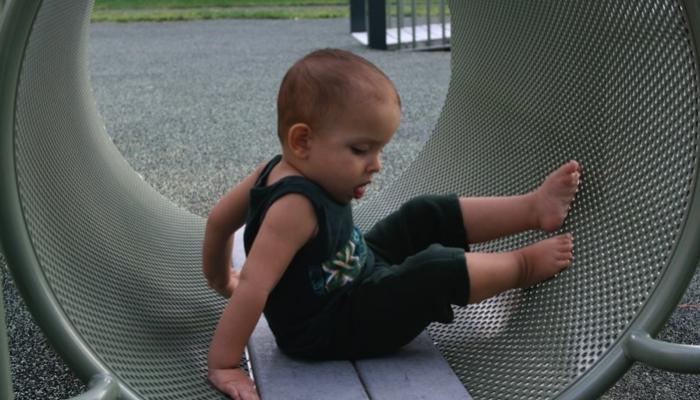
Did you know that it’s never too early to begin teaching your blind baby orientation and mobility skills?
Even if your blind infant is only a few months old and certainly ins’t moving anywhere on her own, orientation and mobility is still a key factor to future independence and many of the basic teachings can begin as early as infancy.
You may now be asking…
Orientation and mobility training (usually abbreviated O&M) is really just another way of saying that blind people need to be taught how to get around independently. Orientation skills help people figure out where they are and mobility skills help them move about.
If your baby isn’t walking (and it’s perfectly normal for crawling and walking to be delayed in visually impaired children), you can still help your baby learn about the environment and pick up on clues and cues that will tell them where they are and what’s coming up next. You may not be ready to teach your baby how to walk with a cane, but you can lay the foundation for basic orientation skills now while your baby is still very young.
Directions and Body Awareness
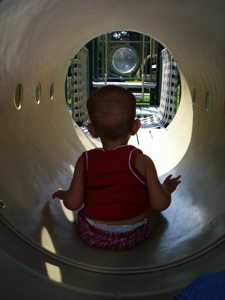
A very basic place to begin is with directions and body awareness. Whenever you have the opportunity, point out directions like left, right, in front, and behind. Get used to saying things like, “Your ball is next to your right knee,” rather than, “Your ball is next to you.” Teaching your baby orientation skills means that you too will have to learn how to talk about orientation properly.
Learning about the self and how the body is connected is a very important beginning skill for blind babies. Play games where you name body parts, sing “Head & Shoulders,” and name body parts while in the bath. Most orientation begins with the person and then moves out to the environment. In other words, when directing a blind child across the room you would refer to their position first (move forward, turn left, etc) then tell them where things are located in relation to their own body (the door is on your right). It wouldn’t make sense to say something like, “The door is over there.” Understanding directions and body parts is very important.
If your child has light perception, use this to your advantage when talking about directions. Point out that the open window is on their right or play with flash lights and have them grab the light or point to it. Being able to decipher open windows or doors, find light sources, or see lighted pathways will help your child tremendously when they begin moving around on their own.
Environmental Sounds
Besides light and directions, sounds play a very important role in orientation. Teach your baby to listen to the cars going by on the street, to the refrigerator humming in the kitchen, or to the sounds of the television downstairs in the living room. Point out that far away sounds are quiet or muffled and pick out important sounds in your house or neighborhood (each room in your house may have a particular sound like a clock ticking or a sink dripping).
Pay close attention to sounds that will help your child get around when they are older, such as cross walk signals or car horns beeping. Also teach them about dangerous sounds they will want to avoid, like a growling dog or a truck backing up.
Games You Can Play Now
Of course, your baby is still just a baby and probably responds best to fun and games, so why not make up orientation games? Here a few that we like to play with our son, Ivan:
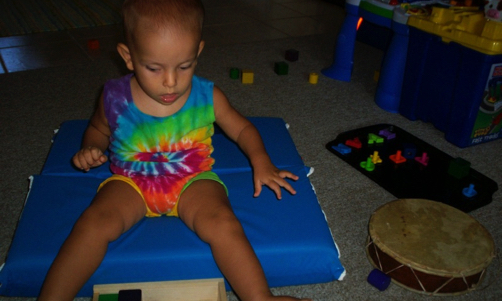
- Listening Play: One of Ivan’s favorite games is to throw his blocks and listen to what they hit. We set him up in the living room with a box of blocks and surrounded by different targets (a cookie sheet, a toy drum, the carpet, the tile floor behind him, etc). He throws blocks in different directions then waits to hear what he hit. This helps him learn to listen and to identify objects in different locations around him.
- Cane Play: See if you can get a hold of a cane for your baby now, even though they aren’t walking yet. We think it’s a great idea to familiarize your child with the object that will be so important to their independence when they get older. You can begin teaching them now that canes make different sounds and feel different in your hand when you touch different objects. Sit your baby in your lap and hold on to the cane with him while you tap carpet, tile, wood, plastic, and other surfaces. Describe the difference in sound and feel.
- Texture Play: Touching different textures with your hands is also very helpful in understanding what’s around you. Take your baby for a walk down the street and have her touch everything while you describe it for her. Some blind babies will react negatively to certain textures, such as sticky or gooey things. If you encounter this problem, put together a “sticky box” where you fill a box with all sorts of sticky things your child just hates to touch. Try to play with the box a few times a week in order to desensitize them. And feeling doesn’t stop at the hands! Be sure to get their feet in that box, too!
- Pointing Play: Another fun orientation game can be to point to things as they go by, like cars going by on the street outside your home. You can close your eyes and join in, too!
Have fun with your baby while you teach them how to pay attention to their environment. These simple games can motivate your child to move independently when they get older and will make their future orientation and mobility training seem easy and natural.
Read this article in Arabic: قراءة هذا المقال بالعربية
Related Posts

Assistive Technology, Orientation and Mobility, Visual Impairment
A New Mobility Technology for Blind Users: Lumen Smart Glasses
Learn about Lumen smart glasses, an innovative assistive technology designed to help blind and visually impaired users navigate safely and independently.

Braille and Literacy, Music Play, Special Needs, Visual Impairment
Braille needs allies. Music can be one of them.
An inspiring look at how music can support Braille literacy, creativity, and inclusion for blind children.

Tactile Arts and Crafts, Visual Impairment
What Does Art Feel Like? A Guide to Tactile Creativity for Blind Children
Discover how blind children explore art through touch. Learn practical ways to support tactile creativity, build early Braille literacy, and nurture imagination with hands-on projects, textures, and accessible art experiences.