
Braille needs allies. Music can be one of them.


In the Paris of once upon a time, when the Bastille was still standing, the big-hearted inventor Charles Barbier was sitting at his piano. More precisely, he was turning the pages of the opera score he had attended the night before. He could not focus on the music. What troubled him was something else entirely.
He was disheartened by the way blind artists were treated on stage, made to perform only for laughter, grateful (poor souls) for the few roles their “life-school in the streets” allowed them. They deserved dignity, not mockery.
Some of his favorite arias were marked by dog-eared corners, folded so that blind fingers could “see” them. And suddenly, like a thunderbolt (in French coup de foudre, which also means love at first sight, or even blind love), he saw the answer to the question that had been haunting him:
How can we teach music to the blind, simply and beautifully?
- What if books were cut with tiny marks that fingers could read?
- What if those marks followed the logic of musical notation?
- What if dots placed on five lines could be read the same way sighted musicians read notes: Mi, Sol, Ti…
- What if Ti meant A, Sol/Ti meant B, and Ti-Ti meant C, and combinations of dots became music and language at once?
More than 250 years later, I tip my hat to him. But to be fair, I must also bow to two other great souls who shaped this path.
First, Valentin Haüy, who founded the very first institute for blind students. He taught them history, mathematics, languages, and music, all through raised Latin letters, believing deeply that blind children deserved full access to culture and knowledge.
And then Louis Braille, who took Barbier’s idea and transformed it into the elegant system we use today, simplifying and refining it, and creating specialized codes for mathematics, music, and more.
This golden triad gave us something priceless: a balance between technology and ethics, between innovation and dignity. Their work reminds us that education is not only about tools, but about respect for the whole human being.
Ten Thousand Students and a Lifetime of Learning
I was once asked, during a public presentation, how many students I had taught in my life. All types, all ages, roughly how many?
Who can really answer such a question?
I tried to estimate, based only on the students I formally registered. I stopped counting at around ten thousand. Each with a name. Each with a face. Each with a story.
Being a teacher is a kind of karma. You carry it with affection, sometimes exhaustion, often gratitude. I can say this with certainty: learning through play never fails. Educational games, music, storytelling, and shared joy are the fastest paths to real learning. Children conquer the world one class at a time when they feel safe and loved.
Blind children are as similar to their sighted peers as they are different. So I will mention only a few truths that guide my work:
- You cannot tell the dancer from the dance. To a blind child, much of what we call “real reality” remains virtual until trust, imagination, warmth, and inner-sight bridge the gap between what is seen and what is felt.
- The arts are the best bridge. Whenever you are with a blind child, you are part of a story that needs to be told in ways they can touch, hear, imagine, and love.
- Music saves the day. Communication breaks down sometimes. That is when a small song becomes a lifeline. Blind children depend on sound in every aspect of life. Teaching music is teaching protection, balance, harmony, values, and wisdom. Few things give such a great return for such a gentle investment.
Why Braille Needs Allies
With this in mind, I created two inspirational ABC albums and pantomime scripts that integrate:
- Braille
- Print (Latin) letters
- Music notation
- Lyrics
- Art
- Storytelling
They are designed for families, teachers, therapists, and anyone guiding blind children in early education. Their goal is simple: to nourish touch, imagination, emotional intelligence, and joy.
These ABCs also respond to a painful reality: Today, only one in ten blind students continues using Braille after leaving school. Audio technology dominates. And only one per generation reaches higher musical education.
So Braille needs allies. Music can be one of them.
In integrated classrooms, where blind, low-vision, and sighted children learn together, shared codes become bridges. My ABCs make it possible to sing together, read together, and grow together.
Whether used in schools, homeschooling, after-school programs, or church groups, these projects welcome everyone.
If the school festival comes first, the ABCs prepare for it. If music training comes first, the festival becomes a gift. Either way: no child is left behind.
Learning print letters alongside Braille strengthens literacy. Learning more than one communication system never harms a child. Blind children can master the sighted world’s lettering, just as sighted children can learn Braille.
The Healing Work of Art
And finally: Art which does not heal is no art.
We live in a world saturated with noise and visual aggression. Children, especially blind children, are more vulnerable to this than we realize. Why burden them with what will disappear tomorrow? Beauty lasts. Beauty protects. Beauty saves.
Everything that lives vibrates: Sound, color, light, words, breath. We need these vibrations like fresh water and clean air.
As educators and parents, we are asked to protect these children’s inner landscapes. My poems, pictures, and music are humble attempts to pack healing vibrations into small, playful steps and invite others to do even better.
Related Posts
Braille and Literacy
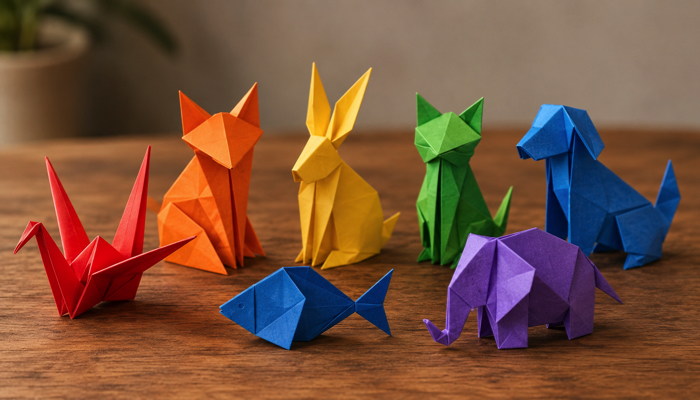
Fold, Feel, Read: How Origami Builds Pre-Braille Skills
Blind adult and origami enthusiast Lindy van der Merwe shares how paper folding can help blind children build important pre-braille skills, including tactile discrimination, spatial awareness, bilateral coordination, and active...

Braille and Literacy
3 Inclusive Creative Writing Games for Blind and Disabled Children
Three creative-writing games transform simple words, numbers, and stories into collaborative poems. These playful activities encourage imagination, teamwork, language development, and creative thinking while helping children discover that poetry can...

Assistive Technology, Orientation and Mobility, Visual Impairment
A New Mobility Technology for Blind Users: Lumen Smart Glasses
Learn about Lumen smart glasses, an innovative assistive technology designed to help blind and visually impaired users navigate safely and independently.