
3 Inclusive Creative Writing Games for Blind and Disabled Children


In memory of my beloved poetry teachers, Marcel Cornis-Pope and Niki Harshanyi
Why Poetry?
Why would we introduce poetry into a music education project? Because poetry is music’s closest relative.
Both are built from rhythm, meaning, imagination, and vibration. Music speaks through notes, while poetry speaks through words. Yet both invite us to listen carefully, think creatively, and discover connections we might otherwise miss.
While developing my tactile music projects for children, I found myself returning again and again to poetry. Children naturally love language when it is presented as play rather than work. They enjoy surprising one another, building stories together, and discovering that there is no single “correct” answer.
The three games below were played with approximately 150 children between the ages of 7 and 11 in music, teacher-training, and language-focused schools. The poems that resulted belong not to one child, but to many voices working together.
That is perhaps the most beautiful lesson of all.
These activities can easily be adapted for classrooms, homeschool groups, therapy sessions, family gatherings, or inclusive groups of children with different abilities.
Game #1: Words in a Hat
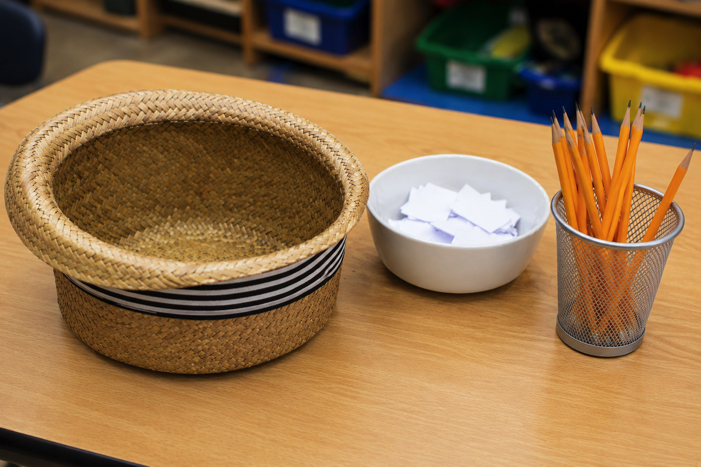
What You’ll Need
- Small slips of paper
- A hat, bowl, or container
- Pencils
How It Works
First, the children choose a topic.
Next, they brainstorm words related to that topic. Every word is written on a separate slip of paper and placed into a hat.
The slips are then drawn randomly, three or four at a time. The challenge is simple: connect those unexpected words into a statement, image, or tiny poem.
As we played, I gently introduced ideas such as comparison, metaphor, and poetic flow, not through lectures, but through discovery. The way I see it, a poem is like a baby fawn. It loves to leap around the page and needs room to move.
The poems were then allowed to “rest” before later refinement. Love, after all, takes time.
Skills Practiced
- Creativity
- Vocabulary
- Listening
- Collaboration
- Storytelling
Sample Poems
row-your-boat like
[...] do-do-dozy kids
teacher at the wall
creaky desk  nosy noise future’s toys sunny days
 sa-aved by the bell [...]
bit of geography
class all-in within my pencil box
transcription of tryst  a paper way out
as idle as copy-pasting water
boredom alert… and lo! the maps
wrap themselves scarce
in my dumb backpack
Adaptations for Blind or Non-Speaking Children
Instead of written words, try using:
- Braille labels
- Tactile symbols
- Small objects placed in a bag
- Recorded words on a communication device
- AAC systems
A rubber duck, toothbrush, key, pinecone, spoon, or toy animal can inspire just as much poetry as a written word.
Remember, the goal of the game is to trigger imagination, not necessarily encourage perfect literacy.
Game #2: You Do the Math
What You’ll Need
- Large numbers
- Silly nouns
- Unexpected adjectives
- A willingness to be surprised
How It Works
For this game, the boys proposed counted objects while the girls proposed unexpected descriptions. Together they created impossible mathematical stories.
The result was not really mathematical but more like poetry disguised as mathematics.
Children quickly discovered that numbers can tell stories, create images, and spark laughter just as effectively as words.
Skills Practiced
- Creative thinking
- Problem solving
- Language flexibility
- Group storytelling
- Humor
Sample Poem
championship factors
637 little footballers chasing 333 moody wabbits
527 gang-gang cockatoos coaching 151 green canaries
plus
286 dappled teddies referees & 117 pink pandas aids’v
341 wild ducks & 592 toothless lizards cheerer-uppers

in how many booties trot they post getting at each other’s ankles?
how many a-flying & how many tiptoeing & how many balls left ok?
who’s winning and who goes home?
drawing near

1912 spaceships & 100 flying houses
[402 SGP sight glasses aboard (each)
monitored by 67 surprising children (each)
assisted by 23 valiant rabbits (each) ]
… draw near  X  hidden slender trees
[ bloomed into 555  roses run hoarse	each
made of 21 mute petals &  393 leaves alive]
each enchanted by 10 robins   golden (each)
… meanwhile 1456 jumpy keys
playing  (each’n every’s) song
 flown into 2 old music books
... so  compute (like whatever)
given that our X  is a lying 8 like infinite
Why It Works
Children naturally expect math to produce one correct answer, but this game invites them to consider a different possibility: What if imagination counts too?
Game #3: As You Like It
What You’ll Need
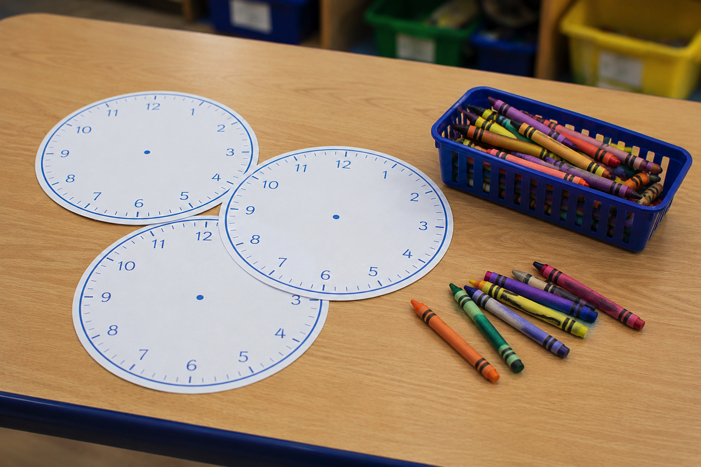
- Paper clock faces
- Markers or crayons
How It Works
Each child receives a clock face without hands. The challenge is to draw the hands so they point to what the child considers the best time of day. The children then explain their choices and connect their ideas into a shared story.
By this point, they already understood something important: Poetry is not mysterious and it is accessible to everyone. They also understood that poetry is collected and hiding everywhere, waiting to be noticed.
The children wanted to return to their original idea of poetry: a beautifully told story.
So together we attempted something more ambitious, building longer narrative poems from the ideas they created.
Skills Practiced
- Sequencing
- Storytelling
- Perspective-taking
- Creative writing
- Emotional expression
Sample Poem
FOIG, ET
 They bumped into FOIG,  Bunny’n young Hedgehog-Sunny:
 “ Dear FOIG, who might you be?”
 “ Does it matter? Me is me… and got robbed as robbed can be!”
 “ Just like this world, no use whining - so let’s go to a fine-dining-
  -blueberries vale! I’m Guard Volpino, and… Hi, dear friend Orsolino!”
 “ I know the thief - spies on us so! Let’s quickly catch’er, go, go, go ! “
But lo’, there she flutters their way… no other than Madame Blue-Jay!
 “You’re busted, sweet life farewell!! Where are my gold coins, pray tell?
 “ Your tinsel chocolate coins, you mean,  glitt’ring brighter than gold?
  Folks are munching’em, unseen in thickets - the young and the old!”
 “Well I never, Madam Blue-Jay! So not guilty? Is that what you say?”
 “ Right, yet would barter, dear things: can I pay back … in ear-rings?”
  “ Stolen, no doubt, ‘cause brighter than gold? Take them back you old
   sick bird, and don’t steal no more! Is this what you spied on us for?
  “Yes, darlings, forgive me! I’m sorry, I'll never again steal, no worry!
   Here’s one coin I saved for you, to dine on & save my soul, too;)”

FOIG couldn’t believe his ears… and sighed “What a world, my dears!”
What Did the Children Think?
Their questions arrived immediately:
“When are you coming back?”
“Can we play these games without you?”
“Do you know any more poetry games?”
My answer was simple:
Yes.
Yes.
And yes.
Why These Games Matter
In a world that often asks children for correct answers, poetry offers something different by inviting curiosity, encouraging listening, and teaching cooperation. Poetry also rewards imagination.
Most importantly, poetry allows children to create something together that doesn’t involve grades or prizes, but instead focuses on the joy of building something beautiful with others.
As Romanian psychologist and former Minister of Education Mircea Miclea once observed:
“In abnormal times, we are called to create oases of normality. One day, perhaps, those oases will join together into a continuum.”
Perhaps poetry is one such oasis.
How about you try these games and tell me what happens?
My bet is that you’ll have just as much fun as we did!
Related Posts
Braille and Literacy
Fold, Feel, Read: How Origami Builds Pre-Braille Skills
Blind adult and origami enthusiast Lindy van der Merwe shares how paper folding can help blind children build important pre-braille skills, including tactile discrimination, spatial awareness, bilateral coordination, and active...

Braille and Literacy, Music Play, Special Needs, Visual Impairment
Braille needs allies. Music can be one of them.
An inspiring look at how music can support Braille literacy, creativity, and inclusion for blind children.

Braille and Literacy, Visual Impairment
Should Blind Children Learn Print Letters?
Discover why teaching both print and braille can enrich literacy for children who are blind, helping them connect with the wider world.