
Fold, Feel, Read: How Origami Builds Pre-Braille Skills

This post may contain affiliate links; please see our terms of use for details.
While attending my first year at a school for blind and visually impaired children, it was decided that, even though I had some functional vision, I would be placed in a class for learners who would be taught braille. Many years would pass before I realized what a good decision was made on my behalf.
It would not only turn out that I would one day work as a braille proofreader, a job which I truly enjoyed and excelled at, but I would also lose my remaining functional sight completely by age twenty-five, which meant that, with my existing braille skills, I could still work, read for pleasure, and use braille in everyday life. In contrast, a friend who lost her remaining sight later in life found herself having to learn braille from scratch as an adult, something that took a lot of time and perseverance, adding to the difficulties experienced while dealing with adjustments after vision loss.
Why Active Touch Matters
When we think of a child learning to read braille, our minds naturally zoom in on their hands. We imagine tiny fingertips gliding over raised dots, and we assume that building literacy is simply a matter of developing a sharp sense of touch and strong finger muscles, and that, perhaps, the rest will happen naturally?
It may mean that early pre-braille interventions focus primarily on fine motor drills, like squeezing playdough, threading beads, or picking up marbles. While these activities are important and certainly build fine motor skills and grip strength, they treat the hand like a mechanical tool operating in a vacuum, when, in fact, much more is going on during this phase of early childhood development.
According to Millie Smith, in order to read braille fluently and understand tactile images, a child needs to develop a sophisticated somatosensory framework: a dynamic combination of active, tactile touch, proprioception (the brain’s internal map of where the hands are in space), and kinesthetic movement (tracking paths and detecting weight or resistance). (Smith, 1998)
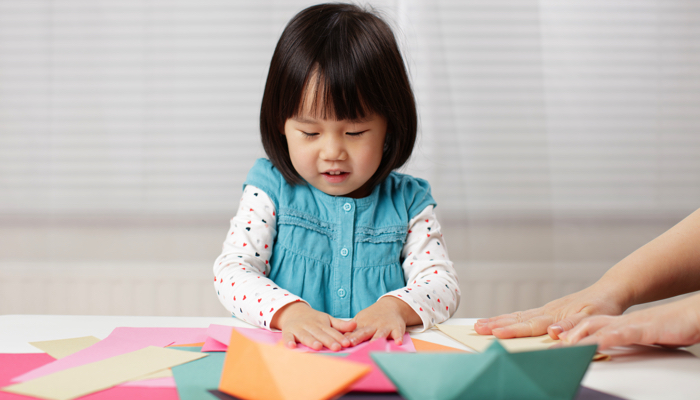
Importantly, Smith’s framework emphasizes that for children with visual impairments, tactile learning must be active rather than passive. Passive touch, like having an object placed into a stationary hand, provides very little functional data. True comprehension comes from active engagement, where the child’s hands gather knowledge about an object’s form, weight, and function through direct use.
Tactile learners receive information about function very differently than sighted children. Sighted children learn function primarily by imitating what they see others do with the object. Tactile learners learn function primarily by memorizing sequences of movements. This memorization occurs when information is gathered through the somatosensory system. In order for information to be gathered, there must be a conscious interaction between brain and muscle. This only happens when a child is controlling at least some of his movements. Control allows information about joint movement to be stored so that movements can be repeated almost automatically in the future. If the child is passively manipulated through a task (think hand-under-hand techniques), no memory of the event is stored, and function cannot be learned.
From my personal experience as a braille user who has also done origami for some years now, it struck me that the two activities not only have a lot in common, but that origami also has the following active, functional learning skills Smith mentions, at its core:
Numerous studies have confirmed that paper folding isn’t just a static craft; it is a dynamic, multi-sensory environment where, it turns out, all seven of Smith’s functional skills, namely locating, exploring, manipulating, recognizing, comparing, organizing, and communicating, are happening simultaneously.
The process begins with organizing, gathering the paper, clearing a workspace, and locating materials. As the child works, they use the craft to communicate with the teacher and friends around them, asking questions about a step or sharing their progress.
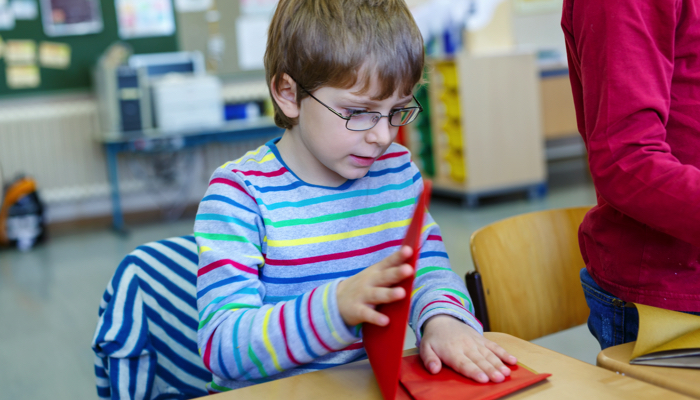
Folding an origami figure requires constant location of corners, edges, and crease lines and actively exploring the paper’s changing outline and surface area. In order to be able to manipulate the sheet into new forms, both hands are needed to constantly compare the symmetry of the left and right sides to ensure the model aligns correctly. Finally, through this given sequence of movements, a recognizable or useful 2D or 3D object is created.
Five Ways Origami Supports Early Braille Learning
The following explains the different components involved in pre-braille skills and highlights how the active, dynamic nature of paper folding mirrors the essential skills needed for the successful development of pre-braille skills and early braille literacy.
1. Tactile Discrimination and Sensitivity: The Foundation of Light Touch
For a child preparing to read braille, the fingertips must transform into highly sensitive scanners capable of identifying microscopic differences in texture and spatial layout. Braille characters exist within a tiny matrix just millimeters wide, meaning a reader must be able to feel minimal raised bumps without pressing too hard or causing physical fatigue. This requires the development of an extremely refined, deliberate “light touch.”
Origami serves as a natural laboratory for this sensory training because it demands continuous, active tactile exploration. As Smith notes, cutaneous sensors in the skin gather rich details about texture, size, and form, but only when the hand is actively moving over an object. When handling origami paper, a child must gently run their fingers across the sheet to locate subtle structural landmarks, like the exact point where two lines cross or where one point meets another. They learn to feel the micro-boundary where a smooth surface meets a crisp, raised crease line. By alternating between the heavy pressure needed to lock a fold in place and the soft, feather-light hold required to position a delicate corner, the child actively builds the precise pressure control essential for gliding effortlessly across a page or a tactile diagram.
2. Proprioception and Kinesthetic Awareness: Intrinsic Strength and Finger Isolation
Proprioception, the brain’s internal map of where the body and limbs are in space, is what allows a braille reader to navigate a page and separate individual movements of their digits. Reading braille is physically demanding; without adequate hand strength, wrist stability, and the ability to isolate fingers, a child will experience rapid muscle fatigue. They need to master the physical stamina to keep their hands stable and the motor control to move specific fingers independently to scan a cell’s unique dot configuration.
Every stage of origami acts as a physical workout for these precise muscle groups through intentional manipulation. For example, when folding paper, a child cannot rely only on a whole-hand grip; they must use a refined pincer grasp to pinch edges and manipulate tiny, tight corners.
This active manipulation strengthens the intrinsic muscles of the hand and stabilizes the wrist, building the exact physical endurance a child requires to sustain tactile reading without tiring.
3. Bilateral Coordination: Two-Handed Harmony and Page Navigation
Fluent braille reading and tactile exploration of a diagram or a graph is inherently a two-handed symphony. Rarely does a skilled reader navigate with a single hand; instead, both hands work in cooperative, asymmetrical harmony. Typically, the dominant hand acts as the primary reader, moving left to right across the text, while the non-dominant hand functions as a steady anchor, holding the page in place or maintaining a physical marker at the beginning of the next line so the reader never loses their place.
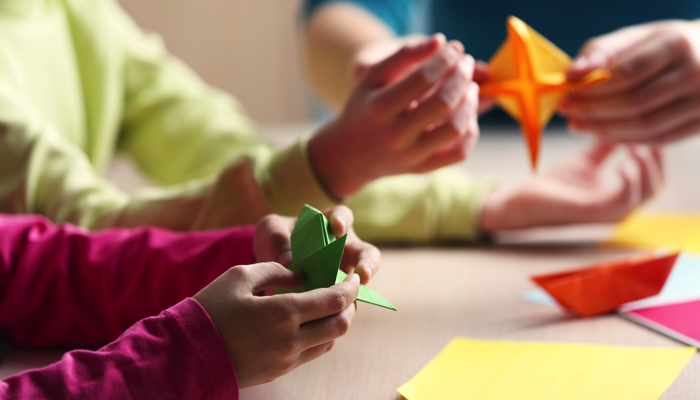
Origami is one of the most effective activities for teaching this level of bilateral coordination because the paper cannot be managed single-handedly. To make an accurate fold, one hand must act as a stabilizer, pinning the base of the sheet to the table or holding a boundary line, while the other hand acts dynamically to pull, stretch, or crease the paper. This constant, two-handed dialogue trains the brain to coordinate asymmetrical movements, creating the exact muscle memory and spatial cooperation needed to seamlessly manage a two-handed braille reading strategy.
4. Tactile Tracking and Scanning: Mapping Paths and Contours
Before a child can decode an individual braille character, they must master the mechanical skill of tracking across a flat plane. Tactile tracking involves moving the hands smoothly and linearly from left to right along a straight path, detecting changes in direction, and dropping down vertically to locate the beginning of the next line. Without this skill, a reader will frequently skip lines, repeat text, or lose track of their spatial positioning on the page.
Being able to track accurately and gather information along the way becomes even more important when working with tactile images. Following contours and finding boundaries is critical for understanding a tactile map, for instance.
In origami, tracking translates into the physical acts of locating and tracing lines. A child must constantly scan the paper to find structural boundaries, intentionally searching for edges or intersection points. To check if a fold is accurate, fingertips have to run along an established crease from start to finish, evaluating its straightness and direction. This physical action perfectly mimics the scanning movement used to track lines on a physical tactile image or on a braille display.
5. Spatial Orientation and Conceptual Language: Geometric and Structural Mapping
Braille literacy relies heavily on a highly developed spatial vocabulary and internal geometric map. It starts off with learning that a braille cell is arranged in a strict top-to-bottom, left-to-right configuration (with dots numbered 1 through 6),
Origami relies on the development of similar spatial concepts, making extensive use of positional language in order to actively create something from a paper sheet. Folding the top corner to the bottom or the left edge over to the right is the starting point for almost every origami figure.
This active geometric mapping anchors abstract spatial words to concrete physical movements, giving children the exact conceptual framework they need to navigate the 2D landscape of a tactile diagram and, in fact, the 3D world around them.
Small Folds, Big Learning
Providing opportunities for Active tactile exploration and functional learning is crucial for the development of pre-braille skills in particular, but also for overall development in general.
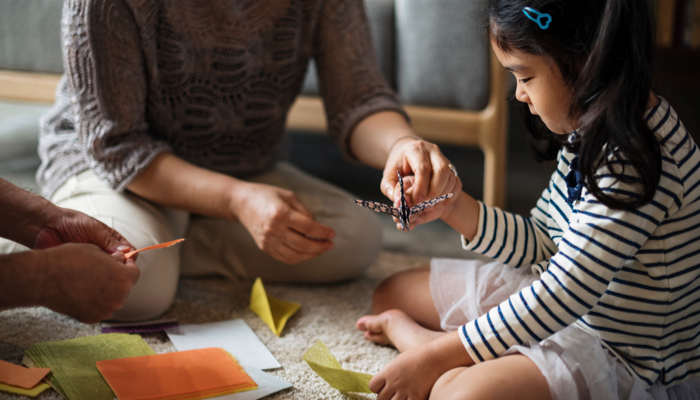
When a child learns to read braille, they aren’t just sitting still letting a page touch their fingers; they are actively moving, searching, and interpreting. Origami requires a very similar active engagement.
Thus, by participating in an engaging craft like origami, a child isn’t just preparing for braille. They are developing the foundational intelligence required to actively participate in learning through touch, social interaction, and just about everything else in life, paving the way toward total functional inclusion and independence.
Recommended Resources and Further Reading
- Access Origami – ACCESSIBLE ORIGAMI – AZ TO 3D – UNFOLDING ORIGAMI THROUGH THE SPOKEN WORD
- Smith, M. (n.d.). Feelin’ groovy: Functional tactual skills. Paths to Literacy.
- Adkins, A. (2018). Early Tactile Learning Profile. Texas School for the Blind and Visually Impaired (TSBVI).
- Warren, D. H. (1994). Blindness and Children: An Individual Differences Approach. Cambridge University Press.
- Hilditch, J. (2023). Pre-braille implementation into early education: Tactile activities to introduce braille concepts to kindergartners.
- van der Merwe, L. (2023). 10 Ways To Help Your Blind or Visually Impaired Child Get Started With Origami.
- van der Merwe, L. (2023). 10 Surprising Ways Origami Can Empower Blind Children.
- van der Merwe, L. (2025). Using Origami to Teach Blind and Low-Vision Students Basic Shapes.
- van der Merwe, L. (2025). From 2D to 3D: Teaching Geometry to Blind Students Through Origami.
Related Posts

Braille and Literacy
3 Inclusive Creative Writing Games for Blind and Disabled Children
Three creative-writing games transform simple words, numbers, and stories into collaborative poems. These playful activities encourage imagination, teamwork, language development, and creative thinking while helping children discover that poetry can...

Braille and Literacy, Music Play, Special Needs, Visual Impairment
Braille needs allies. Music can be one of them.
An inspiring look at how music can support Braille literacy, creativity, and inclusion for blind children.

Braille and Literacy, Visual Impairment
Should Blind Children Learn Print Letters?
Discover why teaching both print and braille can enrich literacy for children who are blind, helping them connect with the wider world.