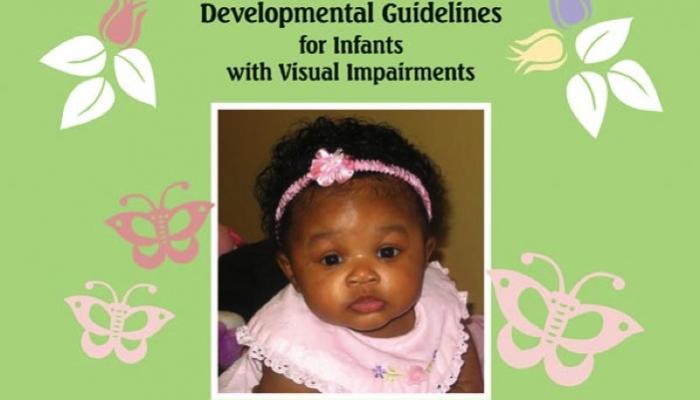
There aren’t very many books that cover the early years of your blind infant and it can be quite frustrating reading books that all begin by talking about your child’s school years. Why is that? Probably because there aren’t very many blind babies. Congenital blindness is pretty rare and most children with visual impairment weren’t born that way. So, when we came across Developmental Guidelines for Infants with Visual Impairment we were thrilled to find a book dedicated to the early infancy development of blind babies.
Developmental Guidelines for Infants with Visual Impairment is available through APH for $29.00 and is well worth the price! This book is a must-have addition to your personal library. It provides information on six strategic areas of development, explains why your blind baby may be delayed in each area, and provides ideas on how to encourage development. Each chapter ends with easy-to-read charts that break down the development goals and offer suggestions for intervention as well as suggestions for further reading.
The guide covers these six areas of development:
Social-Emotional Development
Communication Development
Cognitive Development
Fine Motor Development
Gross Motor Development
Functional Vision Development
Developmental Guidelines focuses on ages birth to two years and though it is written for professionals and can be a bit wordy at times, it’s a great resource for parents, too. After all the reading you’ve done as the parent of a blind baby, I’m sure you feel just about qualified to be a professional anyway!
Learn about Lumen smart glasses, an innovative assistive technology designed to help blind and visually impaired users navigate safely and independently.
Braille and Literacy, Music Play, Special Needs, Visual Impairment
Discover how blind children explore art through touch. Learn practical ways to support tactile creativity, build early Braille literacy, and nurture imagination with hands-on projects, textures, and accessible art experiences.