When your baby is diagnosed with a visual impairment you may feel lost at first. Like many parents, you’ve probably never known anyone who was blind and blindness wasn’t anything you’ve ever really spent much time thinking about. And yet here you are with a baby who is depending on you for so much… What do you do? Where do you begin?
It’s a difficult place to be, but there are so many people out there who are ready to support you!
Here are suggestions for new parents from the wonderful moms and dads in our WonderBaby.org community:
Sing lots of songs and play music.
Explore lots of tactile objects together and read touch and feel books. It’s actually pretty easy to make your own!
Braille will be very useful to your child one day. I learned braille while my child was little (just the alphabet which is surprisingly easy) and got a braille labeler so I could turn any book into a braille book.
Early Intervention was a blessing to our family.
When you talk to him describe everything! And sing sing sing!
Try to let him touch as much as possible and tell him what it is and what it does.
Get help! Sign up for any services that are provided. Look for physical therapy, occupational therapy, speech therapy.
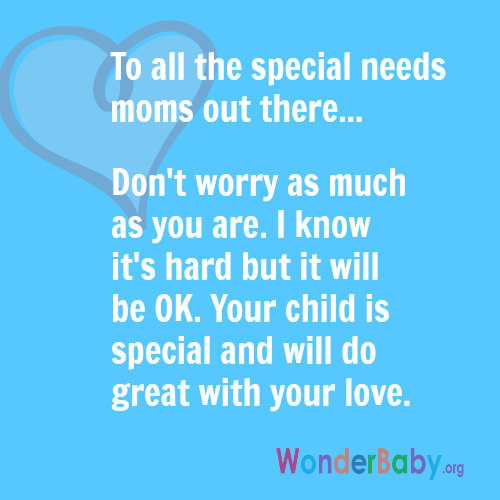
Don’t worry as much as you are. I know that it’s hard but it will be OK. Your child is special and will do great with your love.
Don’t exhaust yourself as it’s easy to feel guilty like you should be doing something every minute. You don’t. It’s OK to just cuddle sometimes.
Look into baby wearing and get him to be part of the everyday routines. It’s soothing, but not over stimulating and he can be more a part of the world.
Create sensory experiences where ever you can.
Get Braille labels and put them on cupboards and drawers so he is comfortable with it as he grows up.
Never forget to communicate with other parents and remember that you are not alone.
The best advice I got was to still give him responsibilities and make him clean up after himself and challenge him.
Narrate everything you do, hear, and see from an early age to open the world to him.
Approach accessibility difficulties with the attitude of it being an opportunity for you and your child to be creative and solve the puzzle together.
Always be prepared to have to think outside the box and adapt, but keep your expectations for your child relatively the same (within reason) to a sighted child, so they reach higher and are encouraged and empowered to be independent.
Just raise your baby like any other baby. It’s really just the same and in time the blindness thing won’t be the big obstacle you imagine. Ok it will be a little harder for a while, but there are lots of aids and help out there! Go with the flow and you will find it won’t be that bad.
WonderBaby founder Amber Bobnar shares thoughts on Braille literacy, multisensory learning, tactile education, and music accessibility for blind and disabled children.
Assistive Technology, Orientation and Mobility, Visual Impairment
Learn about Lumen smart glasses, an innovative assistive technology designed to help blind and visually impaired users navigate safely and independently.
Braille and Literacy, Music Play, Special Needs, Visual Impairment